

You’d think requirements engineering would be easy by now. After all, decades of methodology, tooling, and frameworks have gone into it. Universities teach courses on it, certifications exist for it, and every seasoned engineer has war stories about requirements gone wrong. Yet projects still run off the rails, and fingers still point to “bad requirements” as the root cause.
So why is this practice so tricky? The truth is, requirements engineering lives at the messy intersection of human communication, organizational politics, and technical reality. It’s where abstract business desires collide with engineering feasibility. And it’s here that even seasoned professionals stumble.
Let’s explore the common pitfalls, the costs they incur, and how artificial intelligence can play a role in making this discipline less of a headache. Along the way, we’ll also cover why standards matter, what good documentation looks like, and how AI fits into a reference architecture for enterprise requirements engineering.
The Classic Pitfalls That Refuse to Go Away
Anyone who’s ever written or read requirements knows the pain points:
- Ambiguity: Words like fast, secure, or user-friendly sound fine in meetings but unravel when engineers ask, “How fast? How secure?”
- Incomplete coverage: Functional requirements get captured, but non-functional ones—like compliance, scalability, or resilience—slip through the cracks.
- Scope creep: A few extra “must-haves” sneak in, and before you know it, deadlines are impossible.
- Stakeholder friction: Marketing wants innovation, compliance wants control, and operations want stability. Who wins? Too often, the loudest voice.
- Over-specification: Requirements dictate design choices too early, cutting off better options.
- Lack of traceability: No clear links between requirements, design, code, and tests. Nobody’s sure if the end product matches the original intent.
- Poor validation: Requirements that aren’t testable or measurable sneak through the net.
These aren’t theoretical risks. They show up every day in corporate projects, where complexity and scale amplify every misstep.
The Consequences in Corporate Life
In small teams, missed requirements are painful but manageable. In enterprises, they can be devastating. A missed compliance requirement may mean fines or legal trouble. An overlooked scalability need may cause outages that make headlines. A lack of traceability may cripple audits or erode customer trust.
The costs multiply as errors travel downstream. Fixing an unclear requirement during ideation is cheap. Fixing it after release is brutally expensive. There’s an old engineering adage: every stage you delay fixing a requirements issue increases cost tenfold. Enterprises live this reality all too often.
The impact isn’t just monetary. Broken trust between business and IT, frustrated engineers burning out from endless firefighting, and mounting technical debt all leave scars. In global organizations, different regions and business units pull in different directions, making the problem worse. Vendors and outsourcing arrangements add more moving parts. What could be a minor hiccup in a startup can escalate into a multimillion-dollar disaster in a large corporation.
AI as a Wingman, Not a Savior
Artificial intelligence has become the buzzword solution to everything, but let’s be clear: it won’t solve office politics or human indecision. What it can do is act as an untiring assistant, spotting issues, consolidating inputs, and suggesting improvements.
Think of AI as the junior analyst who never gets tired. It can:
- Flag ambiguous wording.
- Suggest clearer phrasing.
- Highlight contradictions across documents.
- Cluster similar requirements together.
- Track dependencies and impacts when things change.
It doesn’t replace the judgment of experienced professionals. It lightens the load so they can spend time where their expertise really matters—negotiating trade-offs, understanding business drivers, and guiding design.
From Chaos to Clarity: Making Use of Everyday Inputs
Requirements rarely start life as clean, structured statements. They’re born in:
- Emails from stakeholders.
- Chat threads full of half-formed ideas.
- Meeting transcripts.
- Issue trackers.
- Regulatory documents.
Traditionally, analysts had to comb through all this noise manually. AI changes that. It can parse communication streams, extract requirement-like statements, and organize them. Meeting transcripts become structured summaries with decisions, open issues, and draft requirements. Email chains become categorized and deduplicated.
Picture last week’s heated workshop. Five managers argued, three decisions got made, two got deferred, and one person stormed out. Instead of leaving with scattered notes, AI generates a summary: what was decided, what’s pending, and which points look like requirements. Imperfect? Sure. But miles better than relying on memory or sticky notes.
Standards Aren’t Boring—They’re Liberating
Talk of standards often makes teams groan. Templates, checklists, forms—it sounds like bureaucracy. But standards aren’t the enemy. They’re the shared grammar that keeps chaos at bay.
A solid requirement is:
- Atomic: One clear statement, not a bundle.
- Testable: You can check if it’s met.
- Traceable: It links to design, code, and tests.
- Structured: With IDs, rationale, acceptance criteria.
Think of it like cooking. Saying “make dinner” yields chaos. Saying “make a pasta dish with 200g spaghetti, boiled for 10 minutes, served with tomato sauce” creates consistency. Standards don’t kill agility—they enable collaboration.
What a Standard Should Look Like Without Killing Agility
The best standards are lightweight but effective. A simple template works wonders: ID, description, rationale, priority, acceptance criteria. Separate functional from non-functional requirements. Keep statements clear, singular, and versioned.
Agile teams sometimes fear that documentation slows them down. But the irony is, good standards save time. Less time arguing over what “fast” means. Less time fixing preventable mistakes later. Documentation isn’t bureaucracy—it’s efficiency.
How AI Fits the Puzzle
Here’s where the synergy shows. AI can take messy inputs and reshape them into structured requirements. That vague statement “System should be secure” transforms into:
- Requirement ID: SEC-001
- Type: Non-functional
- Description: The system shall encrypt customer data at rest using AES-256.
- Acceptance Criteria: Verify database encryption with AES-256.
AI can prompt for missing fields, validate compliance, and cross-reference new inputs against existing requirements. It can generate test cases, create mock-ups, and suggest workflows. It turns noise into order.
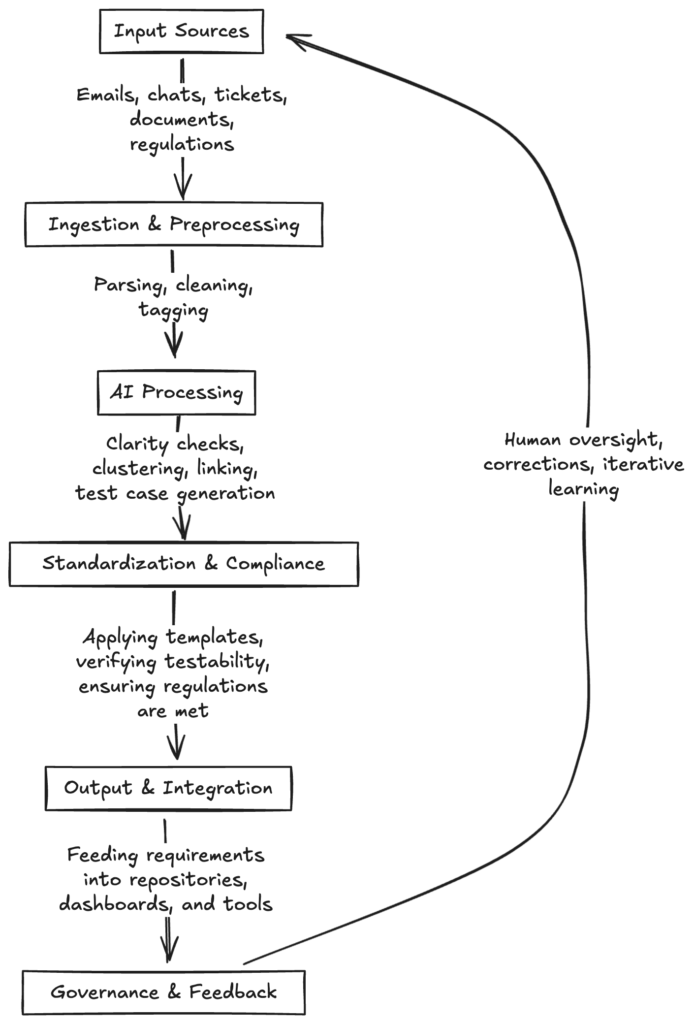
The Reference Architecture: From Input to Governance
Imagine the process as a supply chain:
- Input Sources – Emails, chats, tickets, documents, regulations.
- Ingestion & Preprocessing – Parsing, cleaning, tagging.
- AI Processing – Clarity checks, clustering, linking, test case generation.
- Standardization & Compliance – Applying templates, verifying testability, ensuring regulations are met.
- Output & Integration – Feeding requirements into repositories, dashboards, and tools.
- Governance & Feedback – Human oversight, corrections, iterative learning.
This isn’t static. With each cycle, AI improves. With each correction, the system learns. With each project, governance builds trust.
Culture, Governance, and Trust
The more AI is used, the more vital people become. AI can flag ambiguity, but humans interpret context. AI can propose test cases, but humans decide what matters. Without human oversight, AI becomes noise. With it, AI becomes a partner.
Governance enforces accountability: version histories, rationales, approvals. It’s not red tape—it’s how organizations avoid chaos and prove compliance. Culture matters too. If teams see AI as a threat, they resist. If they see it as a helper, they embrace it. Adoption hinges on trust.
Why This Matters More Than Ever
Requirements engineering isn’t glamorous, but it’s the bedrock of enterprise software. Get it right, and you deliver systems that last, satisfy customers, and pass audits. Get it wrong, and you waste money, frustrate teams, and invite risk.
AI won’t erase the human messiness of corporate life, but it can make requirements clearer, faster, and more reliable. That means fewer nasty surprises, fewer compliance nightmares, and more energy spent building rather than arguing.
And really, isn’t that the point? Software that does what it’s supposed to do, built without unnecessary chaos.
The post continues with part 2.